Mostrando entradas con la etiqueta Hinduism. Mostrar todas las entradas

jueves, 27 de febrero de 2014

Maha Shivratri: The Night of Shiva


Maha Shivratri, the night of the worship of Lord Shiva, occurs on the 14th night of the new moon during the dark half of the month of Phalguna. It falls on a moonless February night, when Hindus offer special prayer to the lord of destruction. Shivratri (Sanskrit 'ratri' = night) is the night when he is said to have performed the Tandava Nritya or the dance of primordial creation, preservation and destruction. The festival is observed for one day and one night only.

Here're three reasons to celebrate Shivratri:

1. The absolute formless God, Sadashiv appeared in the form of "Lingodbhav Moorti" exactly at midnight on Maha Shivratri. That is why all Shiva devotees keep vigil during the night of Shivratri and do "Shivlingam abhishekham" (coronation of the phallic idol) at midnight.

2. Lord Shiva was married to Devi Parvati on Shivratri. Remember Shiva minus Parvati is pure 'Nirgun Brahman'. With his illusive power, (Maya, Parvati) He becomes the "Sagun Brahman" for the purpose of the pious devotion of his devotees.

3. It is also believed that on Shivratri, Lord Shiva became 'Neelkantham' or the blue-throated by swallowing the deadly poison that came up during the churning of "Kshir Sagar" or the milky ocean. The poison was so deadly that even a drop in His stomach, which represents the universe, would have annihilated the entire world. Hence, He held it in His neck, which turned blue due to the effect of poison. Shivratri is therefore also a day of thanksgiving to the Lord for protecting us from annihilation.

The 14th shloka of Shivmahimna Stotra says: "O three eyed Lord, when the poison came up through the churning of the ocean by the gods and demons, they were all aghast with fear as if the untimely end of all creation was imminent. In your kindness, you drank all the poison that still makes your throat blue. O Lord, even this blue mark does but increase your glory. What is apparently a blemish becomes an ornament in one intent on ridding the world of fear."

Origin of Shivratri:

According to the Puranas, during the great mythical churning of the ocean called Samudra Manthan, a pot of poison emerged from the ocean. The gods and the demons were terrified as it could destroy the entire world. When they ran to Shiva for help, he in order to protect the world, drank the deadly poison but held it in his throat instead of swallowing it. This turned his throat blue, and since then he came to be known as 'Nilkantha', the blue-throated one. Shivratri celebrates this event by which Shiva saved.

A Festival Significant for Women :

Shivratri is considered especially auspicious for women. Married women pray for the well being of their husbands and sons, while unmarried women pray for an ideal husband like Shiva, who is the spouse of Kali, Parvati and Durga. But generally it is believed that anyone who utters the name of Shiva during Shivratri with pure devotion is freed froyom all sins. He or she reaches the abode of Shiva and is liberated from the cycle of birth and death.

Shiva Rituals:

On the day of Shivratri, a three-tiered platform is built around a fire. The topmost plank represents 'swargaloka' (heaven), the middle one 'antarikshaloka' (space) and the bottom one 'bhuloka' (earth). Eleven 'kalash' or urns, are kept on the 'swargaloka' plank symbolizing the 11 manifestations of the 'Rudra' or destructive Shiva. These are decorated with the leaves of 'bilva' or 'bael' (Aegle marmelos) and mango atop a coconut representing the head of Shiva. The uncut shank of the coconut symbolizes his tangled hair and the three spots on the fruit Shiva's three eyes

Bathing the Phallus:

The phallus symbol representing Shiva is called the lingam. It is usually made of granite, soapstone, quartz, marble or metal, and has a 'yoni' or vagina as its base representing the union of organs. Devotees circumambulate the lingam and worship it throughout the night. It is bathed every three hours with the 5 sacred offerings of a cow, called the 'panchagavya' - milk, sour milk, urine, butter and dung. Then the 5 foods of immortality - milk, clarified butter, curd, honey and sugar are placed before the lingam. Datura fruit and flower, though poisonous, are believed to be sacred to Shiva and thus offered to him.

"Om Namah Shivaya!":

All through the day the devotees keep severe fast, chant the sacred Panchakshara mantra "Om Namah Shivaya", make offerings of flowers and incense to the Lord amidst ringing of temple bells. They maintain long vigils during the night, keeping awake to listen to stories, hymns and songs. The fast is broken only the next morning, after the nightlong worship. In Kashmir, the festival is held for 15 days. The 13th day is observed as a day of fast followed by a family feast.

http://hinduism.about.com/od/festivalsholidays/p/mahashivratri.htm

lunes, 24 de febrero de 2014

Agni, The Lord Of The Fire And Sacrifice

Agni is one of the most important of the Vedic gods. He is the god of fire, the messenger of the gods, the acceptor of sacrifice. Agni is in everyone's hearth; he is the vital spark of life, and so a part of him is in all living things; he is the fire which consumes food in peoples' stomachs, as well as the fire which consumes the offerings to the gods. He is the fire of the sun, in the lightening bolt, and in the smoke column which holds up the heavens. The stars are sparks from his flame. He was so important to the ancient Indians that 200 hymns in the Rig Veda are addressed to him, and eight of its ten books begin with praises dedicated to him.

Agni is closely associated with Indra, and is sometimes said to be his twin brother. Thus Dyaus Pita and Prthivi are named as two of his parents. But he has many more. Sometimes Kasyapa and Aditi are his parents; another time he is the son of a queen who keeps his birth secret from her king. He was born, like Indra, in full power and vigor. Agni is also said to be the son of ten mothers who are all sisters; these are the ten fingers of man. Another story tells that he consumed his parents when he was born, as they could not provide for him; this is symbolic of the fire born when two sticks are rubbed together which quickly are burned up by it. Dawn and Night are his sisters, his wife is Svaha, and he is the father of Karttikeya.

When Agni was born, the gods conspired to establish a sacrifice. And they wanted Agni to became their priest, they wanted him to give this sacrifice. But he was afraid, "When I lift up the sacrifice and sacrificial fire burned down, then will end my life." And he ran and hid from the gods in the waters. But when Agni disappeared, cheered demons, because there wasn't any lights on the Earth, that overlocked the darkness of the night, and the night was given to the demons in undivided ownership. "We must find Agni", - said the gods leaded by Varuna, the lord and ruler of the night and water, and went in search of. A fish issued residence of the god Agni - she was concerned about the heat that spreaded in the water. In anger Agni cursed her - and by the power of his curse since that time the fish become the prey for people who use it as food. Varuna called Agni: "Come back! Manu, who had escaped from the flood, should accomplish the sacrifice to continue the human race on the Earth. Who besides you exalt his sacrifice to the gods? Come, O Agni! "Agni said:" There was sacrificial fires on Earth who died. I ran like a buffalo from the hunter's arrow because of fear of death. I'll be back, if you give me immortality. " The gods said, "You will our immortal priest, O Agni, Brahma is mercy. You will always be revered in rituals and the victim will belong to you. The universe will forever honor you. " Agni returned and along with his brother Soma he becomed the lord of sacrifices.

When Agni is described in anthropomorphic form, he sometimes has two faces which are smeared with butter. He has seven fiery tongues and sharpened, golden teeth. He is red in color, with black eyes and wild, black hair. He has seven arms and three legs, and seven rays of light emanate from his body. He either rides on a ram, or on a chariot, pulled by goats or sometimes parrots.

Agni loves all his worshipers equally, and so is loved in turn by all of them. He visits everyone's hearth, no matter if they are rich or poor. He is the mediator between the gods and mankind. He is a great consumer of Soma. When people use fire, they must face it toward the proper direction for different uses. When facing East, the fire should be used for sacrifices to the gods; when facing South, the fire should be used for sacrifices to the Manes or spirits of the dead; a cooking fire should always face toward the West. The proper offering to Agni, and hence all the gods, is ghee, which is clarified butter. Agni also had the power to impart immortality on mortals, as well as remove all sins at the time of one's death.

miércoles, 8 de enero de 2014

Tripurasundari - The Godness Who is Beautiful in the Three Worlds


Tripurasundari (Lalita)  is the primary goddess associated with the Shakta Tantric tradition known as Sri Vidya.The Goddess Who is "Beautiful in the Three Worlds" (Supreme Deity of Srikula systems); the "Moksha Mukuta"

'Tripura' means 'the three cities,' and 'sundarī' means 'beautiful,' specifically a beautiful female. Therefore, her name means 'Beautiful (Goddess) of the Three Cities'. Tripura is often popularly translated as 'the three worlds;' however, this is an incorrect translation of the original Sanskrit.

The 'three cities' esoterically refers to a variety of interpretive doctrines, but commonly refers to the triple form of the goddess as found in the triadic doctrine of Shaktism. According to Bhaskararaya's commentary of the Tripura Upaniṣad.

There are three forms of deity: physical (sthūla), subtle (sūkṣma) and supreme (parā). Now the first [physical anthropomorphic form of the deity] is described in its respective meditative verses (dhyānaśloka); the second [subtle form] consists of the [particular deity's] respective root-mantra (mūlamantra); the third [supreme or transcendent form] consists of contemplative worship [of the deity's yantra]. Because deities are threefold in form, contemplative worship (upāsti) is divided threefold respectively into external sacrifice (bahiryāga) [performed primarily to the physical form of the deity], silent repetition (japa) [on the subtle form root-mantra] and internal sacrifice (antaryāga) [in the form of contemplative worship (upāsti) of the yantra].
Even though the bindu cakra [the "drop" in the center of the śrīcakra, is only one point] it has a threefold nature... The three deities created [and] not different from [her supreme] peaceful (śānta) [aspect] are [the three creative powers,namely,] Icchāśakti, Jñānaśakti, and Kriyāśakti. The female deities named Vāmā, Jyeṣṭhā, and Raudrī [identified with the three śaktis are complemented] by the three [male consort] forms of Brahmā, Viṣṇu, and Rudra which are not different creations from [her all-subsuming aspect called] Ambikā.

The traditional interpretation of Tripurā's name in Tantric soteriology involves a rather technical discussion of different levels of spiritual insight and worldly accomplishment, the fate of the individual soul (ātman) in the karmic process, and the concepts of external (bahir-) and internal sacrifice (antaryāga).

Tripura also refers to the Śrīcakra, the yantra that represents the highest vibrational form of Tripurasundari, according to the commentator on the sutra of Gauḍapādā.[6] Bhaskararaya notes in his commentary on Tripura Upaniṣad that the śrīcakra, composed of nine interlocking triangles, is triple in nature.

Tripurasundari is described as being of dusky, red, or golden in color, depending on the meditational form, and in union with Shiva. The couple are traditionally portrayed on a bed, a throne, or a pedestal that is upheld by Brahma, Vishnu, Rudra, Ishana(another form of Shiva, depicted in the Tantras) and Sadashiva forming the plank. She holds five arrows of flowers, a noose, a goad and a sugarcane as a bow. The noose represents attachment, the goad represents repulsion, the sugarcane bow represents the mind and the arrows are the five sense objects.

Bala Tripurasundari is another form of Tripurasundari, depicted as an independent young pre pubescent goddess who is 9 years of age, also known as a kumari. She is said to be the daughter of Lalita Maha Tripurasundari. Bala Tripurasundari's mantra and yantra differs completely from that of Maha Tripurasundari. The only Temple of Bala Tripurasundari Bhagawati is located at Tripurakot of Dolpa district of Nepal where Adhi Shankaracharya had prayed and worshipped due to renowned exaltation of Bala Tripurasundari Bhagawati Temple. Tripurasundari is also worshipped as the Sri Yantra, which is considered by practitioners of Sri Vidya to be a more true representation of the goddess.

Tripurasundari combines in her being Kali's determination and Durga’s charm, grace, and complexion. She has a third eye on her forehead. Usually four-armed and clad in red, the richly bejeweled Tripurasundari sits on a lotus seat laid on a golden throne. An aura of royalty characterizes her overall bearing and ambiance.

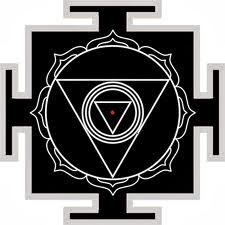
Tripurasundari  Yantra


Tripurasundari Mantra

Shodashi Tripura Sundari - Mahavidya Mantra

http://en.wikipedia.org/wiki/Tripura_Sundari

Tara - The Goddess as Guide and Protector, or Who Saves


In Hinduism, the goddess Tara  meaning "star", is the second of the Dasa (ten) Mahavidyas or "Great Wisdom [goddesses]", Tantric manifestations of Mahadevi, Kali, or Parvati. As the star is seen as a beautiful but perpetually self-combusting thing, so Tara is perceived at core as the absolute, unquenchable hunger that propels all life.

The oral tradition gives an origin to the goddess Tara. The legend begins with the churning of the ocean between the Devas and Asuras. Lord Shiva drank the poison (Halahala) that was created from the churning of the ocean (in the process turning his throat blue and earning him the epithet Nilakantha), thus saving the world from destruction, but fell unconscious under its powerful effect. Tara Ma appeared and took Shiva on her lap. She suckled him, the milk from her breasts counteracting the poison, and he recovered. This story is reminiscent of the one in which Shiva stops the rampaging Kali by becoming an infant. Seeing the child, Kali's maternal instinct comes to the fore and when she was feeding him her breast milk Shiva sucked her rage out while sucking the milk. In both cases, Shiva assumes the position of an infant vis-à-vis the Goddess. Mainly Tara is a form of Durga or Parvati. As Per Shakti Mahabhagwat, She is the one who created 1st Seed from which the entire universe took birth in the form of Lord Vishnu. Since he was Non manifested divinity so next Mahavidya expanded him so that manifested divinity Lord Brahma took birth from him.

Kali and Tara are similar in appearance. They both are described as standing upon a supine Shiva in an inert or corpse-like form. However, while Kali is described as black, Tara is described as blue. Both wear minimal clothing, however Tara wears a tiger-skin skirt, while Kali wears only a girdle of severed human arms. Both wear a necklace of severed human heads and the previously mentioned girdle of arms. Both have a lolling tongue, and blood oozes from their mouths. Their appearances are so strikingly similar that it is easy to mistake one for the other. Indeed, they are often said to be manifestations of each other; for example, in their thousand-name hymns they share many epithets as well as having each other's names. Tara, for example, is called Kalika, Ugra-kali, Mahakali, and Bhadra-kali. Tara is said to be more approachable to the devotee (Bhakta) or Tantrika because of her maternal instincts; however a large population of Bengali Hindus approach Kali herself as "Ma" or "mother".

Like Kali, furthermore, Tara in her Hindu context enjoys blood. In her hymn of a hundred names from the Mundamala-tantra, she is called "She Who Likes Blood", "She Who Is Smeared with Blood" and "She Who Enjoys Blood Sacrifice". The Tara-tantra describes Tara's delight in both animal and human blood but says that the latter is more pleasing to her. The blood of devotees is to be taken from specified parts of the body, such as the forehead, hands, breasts, head, or area between the eyebrows; some of these areas may correspond to the different chakras, spiritual centers within the body.

Tara can be distinguished visually from Kali primarily via her implements. Four armed, she carries a sacrificial sword, a severed head or skull cup, a lotus and scissors. Kali never holds a lotus or a pair of scissors.

Tara Yantra


Tara Mantra

Green Tara Mantra

http://en.wikipedia.org/wiki/Tara_(Devi)

martes, 7 de enero de 2014

Chinnamasta - the Hindu Godness of transformation


Chinnamasta, also known as Chhinnamastika and Prachanda Chandika is one of the Tantric goddesses in Hinduism. In Tantric Buddhism she is known as Chinnamunda. Chinnamasta devi is a form of Shakti who is ferocious and Chinnamasta means, 'severed head'. The Hindu Divine Mother is commonly identified with her fearsome iconography.

Chinnamasta is one of the most outrageous forms of divinity in Hinduism. The self-decapitating Goddess is one of the important and worshipped Shaktipat goddess. Chinnamasta symbolises both life-giver and life-taker. One of the goddesses of Mahavidyas, Chinnamasta is considered both as a symbol of self-control on sexual desire as well as an embodiment of sexual energy, depending upon interpretation.

The mythology emphasizes her sacrifice with maternal element, her sexual dominance and her self-destructive fury. As her approach is dangerous and ferocious, she is not worshipped everywhere. Her temples are mostly found in Northern India and Nepal. So She is recognised by both Hindus and Buddhists. Chinnamasta is closely related to Chinnamunda - the severed-headed form of the Tibetan Buddhist goddess, Vajrayogini.

Chinnamasta is mostly depicted nude and with dishevelled hair in blood red or black coloured body. In the texts, She is described to be a sixteen-year-old girl with full breasts and has a blue lotus near her heart. She is standing over a naked couple. The couple is said to be Rati, Goddess of sexual desire, and her husband Kama, God of love. Chhinnamasta is depicted wearing a serpent as a sacred thread and a garland of skulls or severed heads and bones like Maa Kali. Blood streams out of her neck and Her two female attendants Dakini and Varnini (also called Jaya and Vijaya) are drinking the blood.

On the left hand, She carries her own severed head (in a platter or a skull-bowl). On the right hand, She holds a khatri (a scimitar or knife) by which she decapitated herself.

There are many stories about the birth of Chinnamasta Devi. One legends of Narada-pancharatra narrates this story- Once while having bath in Mandakini river, Goddess Parvati got sexually excited and turned black. Meanwhile Her two attendants Dakini and Varnini (also called Jaya and Vijaya) get hungry and ask the goddess to satisfy their hunger. Goddess Parvati looks around but couldn't find anything to eat. So She severes her head and the blood flows in 3 directions; one in Jaya's mouth, other in Vijaya's mouth and the third in Parvati's mouth.

Another story shows Chinnamasta who is standing over a naked couple which is said to be Rati and Kama. Standing on the body, the goddess masters the physical body, and to free her mind from this, Chinnamasta cuts her head.

Chinnamasta signifies that life, death and sex- three forms of transformation, three parts of the cycle . Chinnamasta is not that popular as an individual goddess. Tantric practitioners worship Chhinnamasta for acquiring siddhis or supernatural powers.

Yantra


Mantra

Chhinnamasta Mantra To Demolish Enemies

miércoles, 20 de noviembre de 2013

The 10 avarars of lord Vishnu


1.VISHNU-FISH

When the great flood came and the Earth vanished, our vast ocean covered all, and then  did not remain on the Earth any single living creature, except the Manu, elect of the gods.  The great Vishnu turned into a huge fish, saved from destruction not only Manu, but many of the divine sages-rishis and the seeds of all terrestrial plants, with which Manu loaded his ship. That's why today our land is green and blooming.


2. VISHNU-TURTLE

Another time, the great Vishnu incarnated on Earth in the form of a huge turtle. That was when the gods are conceived to beat the great ocean to get a drink of immortality Amrita. For that cause the gods even made lasting peace with their eternal enemies - the asuras. Amrita was worth it - because not only people needed immortality, but also the gods. And began the great churning of the ocean, that continued many hundreds of years.

Then lord Vishnu came to the rescue. He appeared in the form of a huge turtle and sank to the bottom of the ocean. The asuras seized for the head of the serpent Vasuki, and the gods - the tail of it, and then began the great churning of which were composed hymns.

3. VISHNU-BOAR

Another avatar of Vishnu came when he saved our land, embodied into the fearless boar Varaha. One demon-asura Hiranyaksha lived in ancient times. He was often in the underworld, which is called Patala, in that huge country, which is larger than the sky and where the palace of the great serpent Vasuki built of precious stones rises. And it  happened that our land, burdened by people, herds, forests and mountains, fell out of our world into a mysterious Patala, in its great ocean and slowly began to sink into the abyss of its dark.

Found out about this, insightful Vishnu was troubled, and turned into a mighty boar Varaha, darted like lightning into the subterranean country. Boar was so strong that one of its canine teased the drowning Earth and pulled it out of the water. But when Vishnu- Boar returned the Earth to our world,  Hiranyaksha attacked him  to take the land and become its complete owner. A great battle broke out between them and continued  thousand of years. The Boar Varaha smit the malign demon and lifted the Earth from the realm of Patala in our world. So it stills in the middle of the great ocean, and never fails in a terrible Patala.

4. VISHNU-LION

The demon Hiranyaksa had an older brother - the king of the Asuras Hiranyakasipu. Brahma himself patronized the king and granted him the divine right to win always. No one could beat Hiranyakasipu - neither men nor beasts, the asuras or the all-powerful gods. Invincible king of the Asuras prouded. He became to oppress everyone and ordered to slaughter to his son Prahlada.

But Prahlada praised Vishnu, and the prayer helped him. Swords of the soldiers blunt and could not harm him. Then the king ordered to throw him into a pit of poisonous snakes, but even their deadly bites were powerless. Angry elephants failed to stamp out the Prahlada and even thrown to the bottom of the ocean, he continued to offer up a prayer to his patron Vishnu. Asura's king was angry at the rebellious prince and locked him in an impregnable prison.

Vishnu came here to help to the faithful Prahlada. He knew that no one living couldn't win the cruel king of the Asuras, and for this Vishnu incarnated neither into a beast nor at a man, but in Narasinha with the body of a lion and a human head. Enraged Hiranyakasipu rushed at him, but mighty Narasinh ripped the king of Asuras with his sharp claws into small pieces.

5. VISHNU-DWARF

The king Asu Bali was a mighty grandson of Prahlada that surpassed his grandfather with the virtue. That's why he got the power over the sky, the earth and the underworld, over all the three worlds called Triloka. And it so happened that the whole universe - Triloka- was owned by the asuras.
Even the gods had to submit to Bali. The mother of all gods Aditi pleaded:
- My son, Vishnu! Great sorrow has befallen us! Flouted the law of justice! Only you, O the wiseted of my sons will be able to return justice to the world!
- Oh great mother of the gods, Aditi! I'll do your will. I'll return the kingdom to my brother, Indra!
Then Vishnu incarnated into a little dwarf Vamana , and it was his most artful Avatar.

The dwarf Vamana  asked the mighty king of the asuras  not too much - just a piece of land, which he will be able to measure with his small steps. Asura's king Bali laughed and readily agreed. Instantly the dwarf turned into a giant. Vamana covered the entire sky with his first step, with the second - the whole earth. But he didn't made the third step, sparing the virtuous king Bali. Therefore only the underground country Parala remained in the possession of the asuras and the sky with the earth belong to the great gods.

6. PARASHURAMA

Parashurama was emerged in the universe for the exceptional purpose regarding to brahmans and kshatriyas. In Tretayuga, all kshatriyas had become very arrogant and were repressing the all brahmans, therefore he strong-willed to revenge and protect the all brahmans from Kshatriyas in the universe.

Parashurama who was a son of saint Jamadagni and Renuka, belonged to the Brighu clan (gotra). He was a fervent devotee of Lord Shiva from whom he blessed with an axe after his strong penance (devotion) therefore Parashurama preferred to preserve an axe presented by Lord Shiva. Parashurama is immortal ( Chiranjeevi ).

One day when Parashurama was not at home, Kartavirya-arjuna who was a powerful king, visited to Jamadagni's home with his army once. Saint Jamadagni welcomed them with loyal heart and fed them all by offering milk and foods through his divine cow Kamadhenu and the King was satisfied with the meal. Jamadagni's cow Kamadhenu was really almighty as it had the capability to provide endless food according to the desire.

When King Kartavirya-arjuna saw this miracle, he surprised and thought about to bring that cow into his palace. So he demanded to saint Jamadagni to take Kamdhenu with him but Saint Jamadagni refused as Kamdhenu was needed to him in his all religious ceremonies. The king got angry and ordered his soldiers to snatch Kamadhenu cow which was supposed to give eternal quantity of milk and food.

Jamadagni was enraged as king’s soldiers took away Kamadhenu, therefore he brought Kamadhenu back by killing the King. When King’s son came to know this, he turned to Jamadagni’s home and killed him. On hearing this all things, Parashuramawas much angered and went for revenge of his father’s death and killed the whole clan of Kartavirya-arjuna and all kshatruas in 21 battles.

7.RAMA

He played a vital role as a main character in the epic Ramayana in the era of Tretayuga. The main purpose of this incarnation was to present the ideal character in every role such as an ideal person, an ideal son, an ideal husband, an ideal king.

Rama, the prince of Ayodhya, was the son of great king Dashrath and queen Kaushalya. Lord Vishnu was incarnated himself as Rama to destroy the all demons (asuras) main the King of Lanka (presently known as Shree Lanka) named Ravana-with ten head who had blessed with a boon from Brahma and also from some other celestial beings. Ravana had so proud of his power and illusion that no body can kill him and he was vainglorious by nature and wished to be vanquished or won by man.

In Tretayuga Lord Vishnu was in form of Rama and his consort (wife) Goddess Laxmi - in form of Sita. In Ramayana, the story of war between a Demon Ravana and Lord Rama is so exciting. Rama was banished by his step mother to a forest so he went away with her wife Sita and brother Laxmana. As Ravana snatched Sita, Rama released her with Hanuman - his loyal devotee and Laxman - his brother by a war. By this war he removed all evil elements from the Universe including the main Demon Ravana.

In Ramayana, the role of Shree Rama epitomises the ideal behavior of man. In this incarnation he focused on the relation of man-wife, son-father, son-mother, brother-brother, master-loyal sevak (servant) and main relationship between king-people (Raja-praja) with his rules for ideal governance as a king.

Lord Rama is one of the most famous gods in the Hindu religion as he was the mythical, fabulous and real King in the ancient India. He has given the message of equality, Hindu devotion and mainly the rules of Dharma.

Lord Vishnu's incarnation as Rama was really in ideal form..

8. KRISHNA

 Avatar, is the eighth incarnation Lord Vishnu with his brother “Balarama” in the form of cowherd as Krishna who had played a vital role as a central character in the epic Mahabharata in the era of “Dwaparyuga”. In the major epic of Indian legends a countless of topics are covered, including brotherhood, love, war, politics etc.

It is basically the story of two warring groups of cousin brothers, the Pandavas and the Kauravas. During the war, as a main part of the Mahabahrata, Krishna gives a long discussion to his disciple Arjuna that communally termed as “Bhagvad-Gita” in that he repeated his words again as he is a preserver of the Universe.

He said,
“Whenever Dharma, the situation of law and order is endangered on this world, I incarnate onto this world to re establish Dharma, truth, law and order; protect the Sadhus, sages or saints and destroy the evil elements of the earth.”

During his child-hood, Krishna became a slayer of King Kansa.  As Krishna was so charm, he captivated to all by playing flute including Gopikaas that’s why he is considered to be an ultimate Playboy but he spread the message of love and humankind. Lord Krishna, the perfect incarnation of Lord Vishnu also famed as "Shyam" according his names meaning: Krishna-black as well as charming (attractive).

This was differ than Ramayan as Mahabharata conducts with more, down to the earth issues such as human weaknesses, politics, human nature and moreover does not effort to idealize the noble characters as in Ramayan.

Lord Krishna is the most worshiped deity and great incarnation of Lord Vishnu.

9.BUDDHA

''Buddha'' means 'the enlightened one' and he proved his name. He was the great abstainer in a form of prince who abdicated the coronation to lead the universe on the path of peace and became the founder of the Buddhist religion that well-known across the globe.

He was son of Suddhodana and Maya, born the crown prince of the Kapilavastu. He was named as “Siddhartha” means "All things fulfilled" by the king. After his birth in very short time his mother died. Fortunately Prajapati - the sister of Maya brought Siddhartha up.

Buddha was saddened by death of living creatures, since his days of childhood. He used to question: "Alas! Do all living creatures kill each other?" He wasn't satisfied with any answers that were given to him and he decided to find out the meaning and the absolute truth.

He taught and observed that all sorrow comes from attachments and desires, so it's better to curb all attachments in order to remain happy.
So one day he left his wife and child and decided to live as a hermit's life and went away in the forest and became the enlightened one. His sermoning spawned off the religion of Buddhism now admired across the whole world.

Lord Buddha is considered as a noble and a divine incarnation (avatar) of Lord Vishnu in assured sects of Hinduism.


10. KALKI

Avatar is the tenth, last and great incarnation of Lord Vishnu. The Lord Vishnu will be emerged as Kalki incarnation. Yet this incarnation is not appeared on the universe but it is expected that lord Vishnu will incarnate at the end of Kali yuga. The period which is currently exist, is Kali Yuga and will be ended when lord Vishnu will incarnate as Kalki and destroy the foulness.

In Kalki Avatar, Vishnu will be in the form of powerful machine-man with extra ordinary strength and will be looked as awesome man who will come in the pose of riding on his white horse with his blazing sword in his hands.

This all things are supposed that to be happened in a future means at the end of "Kali Yuga - present in incarnation of Lord Vishnu. As Lord Vishnu is the preserver, he will incarnate himself in a form of Kalki, destroy the evil spirits punishing them and again reestablish the golden age with the Dharma, order, truth and law

domingo, 17 de noviembre de 2013

Kali -the goddess of the death and enlightenment


Kali comes from the Sanskrit root word Kal which means time. There is nothing that escapes the all-consuming march of time. In Tibetan Buddhism Her counterpart is male with the name Kala. Mother Kali is the most misunderstood of the Hindu goddesses. The Encyclopedia Britannica is grossly mistaken in the following quote, "Major Hindu goddess whose iconography, cult, and mythology commonly associate her with death, sexuality, violence, and, paradoxically in some of her later historical appearances, motherly love."

It is partly correct to say Kali is a goddess of death but She brings the death of the ego as the illusory self-centered view of reality. Nowhere in the Hindu stories is She seen killing anything but demons nor is She associated specifically with the process of human dying like the Hindu god Yama (who really is the god of death). It is true that both Kali and Shiva are said to inhabit cremation grounds and devotees often go to these places to meditate. This is not to worship death but rather it is to overcome the I-am-the-body idea by reinforcing the awareness that the body is a temporary condition. Shiva and Kali are said to inhabit these places because it is our attachment to the body that gives rise to the ego. Shiva and Kali grant liberation by removing the illusion of the ego. Thus we are the eternal I AM and not the body. This is underscored by the scene of the cremation grounds.

Of all the forms of Devi, She is the most compassionate because She provides moksha or liberation to Her children. She is the counterpart of Shiva the destroyer. They are the destroyers of unreality. The ego sees Mother Kali and trembles with fear because the ego sees in Her its own eventual demise. A person who is attached to his or her ego will not be receptive to Mother Kali and she will appear in a fearsome form. A mature soul who engages in spiritual practice to remove the illusion of the ego sees Mother Kali as very sweet, affectionate, and overflowing with incomprehensible love for Her children.

Ma Kali wears a garland of skulls and a skirt of dismembered arms because the ego arises out of identification with the body. In truth we are beings of spirit and not flesh. So liberation can only proceed when our attachment to the body ends. Thus the garland and skirt are trophies worn by Her to symbolize having liberated Her children from attachment to the limited body. She holds a sword and a freshly severed head dripping blood. As the story goes, this represents a great battle in which she destroyed the demon Raktabija. Her black skin represents the womb of the quantum unmanifest from which all of creation arises and into which all of creation will eventually dissolve. She is depicted as standing on Shiva who lays beneath Her with white skin (in contrast to Her black or sometimes dark blue skin). He has a blissful detached look. Shiva represents pure formless awareness sat-chit-ananda (being-consciousness-bliss) while She represents "form" eternally supported by the substratum of pure awareness.

By not understanding the story behind Mother Kali it is easy to misinterpret Her iconography. In the same way one could say that Christianity is a religion of death, destruction and cannibalism in which the practitioners drink the blood of Jesus and eat his flesh. Of course, we know this is not the proper understanding of the communion ritual.

Attaching the idea of sexuality to Mother Kali has no basis in Her at all. There is nothing that associates Her with sexuality in the Hindu stories. In fact it is just the opposite. She is one of the few Goddesses who is celibate practicing austerity and renunciation!

The notion that She is the goddess of death, sex and violence is simply utter nonsense. When we study the life of the great saint Ramakrishna or the great poet saint Ramprasad (both famous Kali worshippers), or listen to the traditional Hindu devotional songs to Kali, there is no hint of this death-sex-violence notion.
Kali is the goddess of enlightenment or liberation.

Yantra


Mantra

Kali Maa Jaap Mantra

sábado, 16 de noviembre de 2013

Rudra (Shiva) from the book "India: The gods and heroes" by E. Geraskina

Great was the fierce god Rudra, the son of Brahma, the fruit of his wrath and fury. He lived alone in the north, in the desert mountains, and he had great power over all the animals.

Dressed in the skins of wild animals, with matted black hair, he wandered the forest with his bow and arrows, with a heavy stick in his hands. Rudra was very beautiful, but the beauty horrendous. His smile shone like the sun, he was quick in his movements and is invulnerable to enemy arrows. His neck was blue, the abdomen was black as night, the back is red as fire. And when he was running for his magic chariot, it was like a red wild boar of the sky.
Once on top of the great mountain Himavati gathered gods sacrifice. Daksha God forgot to invite to the feast of the powerful Rudra. Terrible anger swept Rudra. Furious, he appeared at the top of the mountain Himavati and made great slaughter, which caused shudder with horror all the other gods. Mingled earth and the sky, dimmed the stars, the moon and the sun, terrible darkness engulfed the world.

The gods were frightened and fell down before Rudra. But the anger did not abate Rudra. To the god Pushanu, the keeper of roads and herds, Rudra was knocked out  by his bow all the teeth, to the god of happiness and wealth Bhaga - the eyes, to the god of the sun, Savitar, whom everyone called gold because gold was his eyes, hands, hair and clothing, ripped Rudra fierced hands. But worst of all punished Rudra its main offender Daksha, whom he carried the head. Then  the wounded gods  picked up terrible howl and cry, begged for mercy, and the string shapped on the bow of Rudra. His anger was replaced for mercy, and turned his anger into steam. He returned to God Pushan his teeth, and to  God Bhaga  - his eyes. However, since those times the god Pusan ​​can eat only porridge, for this reason the people brings him only porridge. The god of happiness and wealth Bhaga stayed blind, for this reason the people say that the human destiny and happiness are blind. To help to the god of the sun, Savitar, the mighty Rudra asked the skillful magic wizard Tvashtar to attach to Savitar his golden hands. Today Savitar continues to extend his golden hands-rays to the Earth.

Rudra wanted to help to Daksa too, but as tried to find the severed head of the gods Lord of all creatures on earth, they could not - apparently, it had rolled somewhere far, far away. And the head of the goat was held to the body of Daksha. So he was left with a goat's head.

Rudra complained to the Progenitor Brahma that he was not invited to the feast by the younger gods, although Rudra was the eldest among them because he was created by Brahma before. And Brahma commanded to all the gods and asuras to praise and to worship Rudra and to bring him victims. The dominion to over all living things on earth. was giving to Rudra. He could not only kill by his black arrows, but also send the disease to humans and livestock. To those who praise him, the mighty Rudra can help to get rid of the disease and deterioration. To those who pray to him and ask him for help, the terrible Rudra is kind and responsive. That's why people started calling him Shiva, which means "merciful". Those who did not do to Rudra divine honors, he sent his serpentine children who crawled to human habitation, and brought with them disease and unhappiness.

Rudra had other children - Marutas. They were born when Rudra, becoming a bull, married the Earth, which was trying to hide from the Almighty Rudra in the form of spotted cow. Marutas were strong and powerful, reminding to everyone his father Rudra. Exactly to Marutas the god Indra took to his army, he loved them as their own children, dressed him in golden armor and helmets, and led them to his nomerous trips. Marutas - the loyal retinue of Indra, he is their lord and protector, and they pay him with devotion and love.